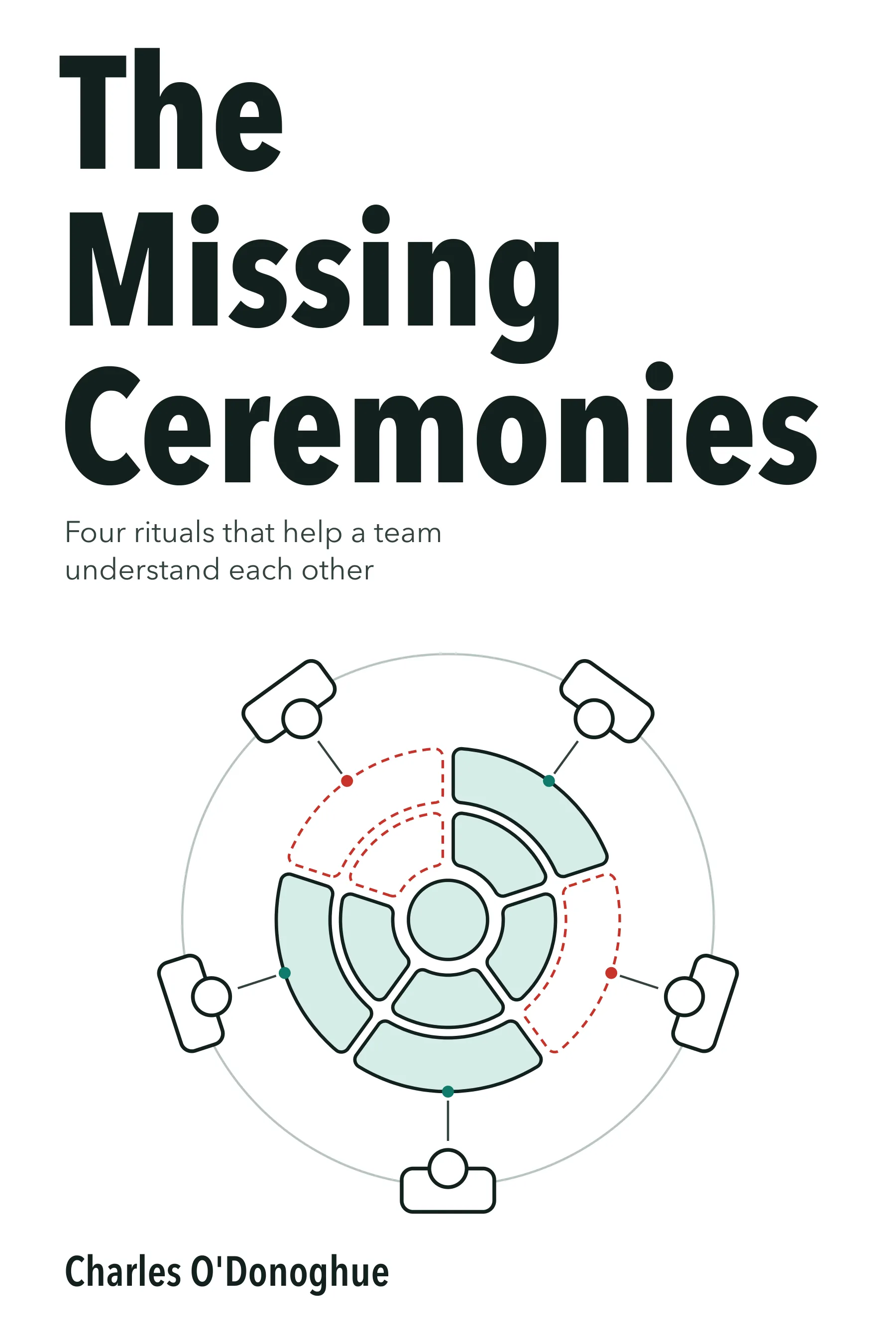
The Missing Ceremonies
publishedFour rituals that help a team understand each other. Scrum gives a team ceremonies for the work; this book is the missing set, for the people doing it.
- Opened
- April 2024
- Format
- PDF and EPUB · Leanpub
- Edition
- First, October 2026
- Length
- 10 chapters, 76 pages
- Price
- Pay what you want, from $9.99
The book
A business is its people. Not “people are important”: the people are the thing. So emotional management is not a soft skill, it is core business strategy, and culture is strategy because culture decides how anything gets executed.
The book’s method is feedback. Not the gentle kind we get once we have enough experience to coast, but the kind that hurts a little, like the burn from the flame, and moves you one notch along. Taking that kind of feedback well needs emotional intelligence, and most of us stop developing it once we have enough to get by. Work takes up a large share of our waking hours, which makes it a good place to start again.
Every time we talk, we lose some meaning. Tone, gesture and words that mean different things to different people open small holes in our understanding, and a working relationship full of holes eventually breaks. The book’s key idea is the adapter: the translation layer two people build so that what one means is what the other hears. The ceremonies are how a team builds and repairs it.
Four ceremonies
None of them is new. I call them ceremonies because each is a set slot for something that isn’t normal work. Two recur and two are triggered.
| Ceremony | When | What it is |
|---|---|---|
| Small Victories | Weekly | Ten minutes where people name their progress and someone responds |
| The Culture Box | When the team forms or changes | A charter the team writes together, and reopens when something changes |
| The Hot Wash-Up | After a specific event | A debrief on what happened, with rules for how it’s run |
| The One-to-One | Fortnightly | Feedback both ways between a manager and one person |
I’ve run the Culture Box, the Hot Wash-Up and the One-to-One with real teams. Small Victories came out of the research and I haven’t yet run it with a team; the book says so, and treats it as an experiment.
The system
Ceremonies meet needs. Met needs build psychological safety. Safety frees capacity that anxiety was using, which shows up as better work, which justifies the time spent on the ceremonies. Delays matter: emotional problems surface months after their causes, which is exactly why a regular balancing loop earns its place.
Who it’s for
Software and product teams, and the managers who lead them. That’s my background, but the ideas travel beyond software. Read Part I once; keep Part II to hand, open a ceremony chapter on Monday and run it on Tuesday.
What’s inside
Part I: Ideas, the emotional architecture of work. The argument, built from system dynamics and self-determination theory, with a simulation built for the book.
- A Radical New Picture
- Why Emotions Matter in Business
- System Dynamics: A Mental Model for Business
- Self-Determination Theory and Psychological Needs
- What the Model Says
Part II: Practice, meetings that manage emotion. Each ceremony with how to run it, what goes wrong and how you know it’s working.
- Small Victories
- The Culture Box
- The Hot Wash-Up
- The One-to-One
- The Inner Game of Feedback
Then a conclusion, Emotion as a Strategic Asset; Appendix A, on the model behind chapter 5; and the references. The free sample has the preface, Part I’s opener and chapters 1 and 2.
A look inside
Two figures from chapter 1: the adapter between two people, and the same idea scaled up to a team of five.
Checked
Every study the book cites was checked against its source: authors, year and journal against the publisher’s records, and each claim against the paper itself. Nine claims didn’t match their sources, and the text changed to match. The epigraphs that open each chapter were checked word for word against the original texts. Where a chapter rests on thin evidence, a box says so.
An AI-forward book
It grew out of a talk Easee asked me to give after COVID, on why my team, spread across Germany, the Netherlands, the UK and Norway, was handling remote work so well. The practice is mine, learned the slow way with real teams. AI drafted and tightened many of the sentences and did most of the source reading; I checked it, argued with it and made every call on what stayed. The preface says which part is which.
Standing on
Donella Meadows’ Thinking in Systems; Deci and Ryan’s Self-Determination Theory; Shelly Gable’s research on how people respond to good news; Amy Edmondson on psychological safety; Nancy Kline’s Time to Think; Jeff and J.J. Sutherland’s Scrum.
Buy it once
The book is on Leanpub, so buy it once and every new edition is yours, free. This first edition is marked 90% complete: Appendix A, on the model, is still being finished, and it will arrive as a free update.